
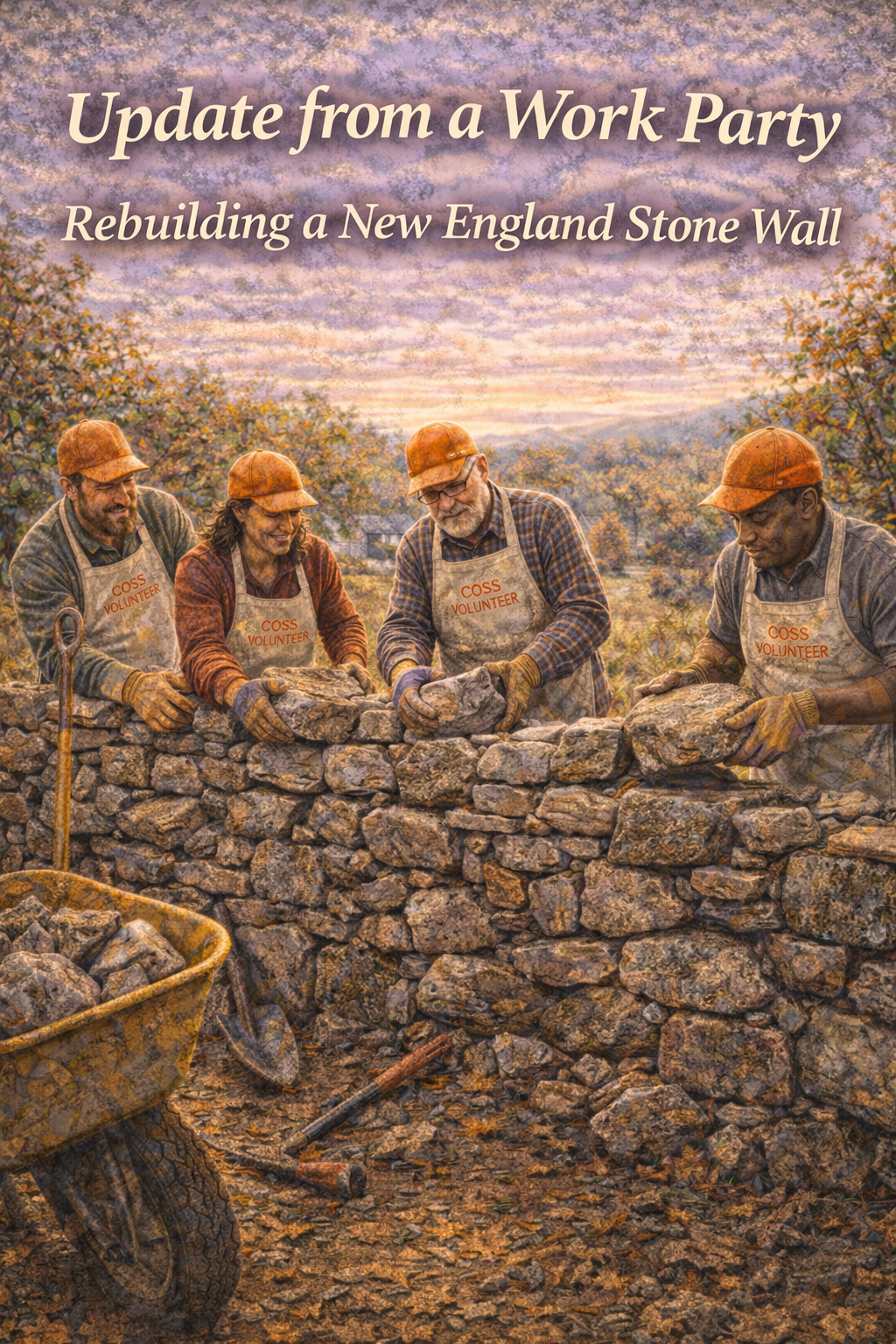
One of the most interesting features of Koulas Farm is its long, historic, and original dry-stacked stone walls. Once all the vines and brush are removed, the walls will be carefully restored and maintained to keep alive the traditional skills used in stone wall building and to preserve a visible link to the town’s agricultural past. Chelmsford is full of these hand-built walls, many dating back to the 1700s and 1800s when farmers cleared stones from their fields and used them to mark property lines, separate livestock, and define pastures. Dry-stacking means no mortar is used, each stone is carefully balanced so that weight and friction alone hold the wall together.
Fun facts:
• Chelmsford has more than 250 miles of old fieldstone walls, much of it still traceable on conservation land and old farmsteads.
• Many of these walls mark the boundaries of the town’s earliest farms and were built from glacial stones left behind as the last Ice Age ended.
• Skilled wallers often used special “through-stones” to tie both sides of the wall together, a technique still visible in well-preserved sections.
• In some places, stone walls doubled as wildlife corridors, offering shelter for chipmunks, snakes, and toads while defining historic routes used by oxen and farmers.
• Massachusetts is said to have more miles of stone wall than there are miles of highway, and Chelmsford’s examples are among the best preserved in the Merrimack Valley.