
Rock Bar 101 – Old Tools That Still Work Wonders
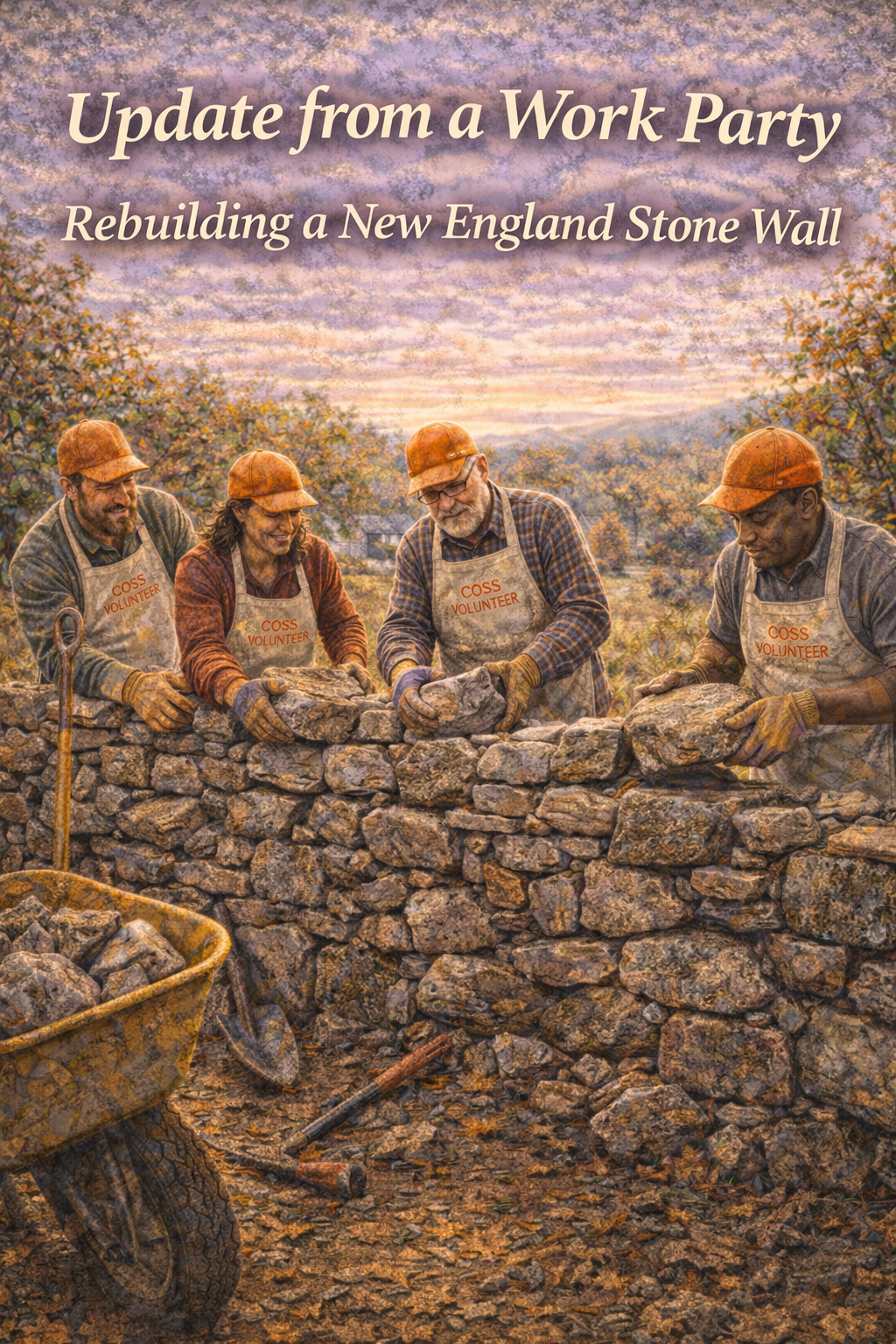
Yesterday’s work party at Koulas Farm gave me a chance to introduce some very old technology to new users. This wasn’t for a history lesson or nostalgia, it was because this technology just works, and it works well.
New England is known for cold winters, warm summers, and beautiful fall colors. But if you ask a farmer what the best “crop” is that comes from these changing seasons, the answer is usually the same: rocks. Frost and thaw slowly push rocks up from the ground year after year. The thousands of miles of stone walls across New England aren’t just about beauty or boundaries, they’re how generations of farmers stored all those rocks.
Koulas Farm was once a dairy farm, mainly because the rocky ground made crop farming difficult. Cows don’t mind grazing around stones, but for our current goal of creating a more family friendly field, those rocks are trip hazards and hard on mowing equipment. The stone walls have also suffered from decades without maintenance, as tree roots, frost heaves, and vines have caused sections to collapse.
Yesterday’s crew of more than twenty volunteers, including members of the Chinese Bible Church of Greater Lowell, tackled these challenges head on. It was a big group, and the work was organized in phases so everyone could learn the process and see results right away.
Phase 1 – Clearing and exposure
The first step was to open up the area along the old walls. Over the years, saplings, vines, and low brush had taken over, hiding the walls and making it difficult to see where new rocks had surfaced. Crews used loppers, rakes, and hand saws to clear the line of sight from one end of the wall to the other. This revealed not only the original stonework but also the scatter of new rocks that frost had pushed up over decades.
Phase 2 – Raking and surface cleanup
Once the brush was cleared, a raking team went through to expose the soil surface and uncover the tops of buried stones. This step made it easier to see which rocks were small enough to lift by hand and which ones would need heavier tools or later help from the DPW equipment.
Phase 3 – Rock popping
Then came the most satisfying part, learning how to pop rocks. Using old style rock bars, volunteers learned to feel the ground, find the edge of a buried rock, and use leverage instead of brute strength to bring it up. Each bar is a solid steel rod about five feet long, pointed at one end and sometimes flattened at the other. When you push the tip into the soil and lean on it, you can feel the rock shift. Add another bar or a shovel, and suddenly the rock breaks free of the earth. It’s a skill that looks simple but takes practice to master, and by mid afternoon everyone had learned the rhythm of it: dig, lever, feel, pop. There was a lot of laughter, teamwork, and a few cheers every time a big one came loose.
Phase 4 – Rebuilding and wall repair
After rocks were popped, teams moved them to the nearest section of wall. Some went into open gaps where frost had knocked earlier stones loose, while others were stacked in neat piles ready for future wall restoration days. Volunteers quickly learned that stone wall building is a bit of an art form. Large flat stones at the bottom, smaller ones on top, and always two rows with a filled center to keep things stable.
By the end of the afternoon, the crew had cleared and restored about seventy feet of wall and exposed over a hundred rocks, moving about eighty five percent of them by hand. The rest are ready for the next phase when the DPW can bring equipment to move the larger monster rocks.
Fun facts about stone walls and tools
• Massachusetts is estimated to have over 100,000 miles of stone walls, more than the total length of all roads and highways in the state combined.
• Most walls were built between 1775 and 1850 during the height of farming in New England. Clearing new pastureland produced so many stones that walls became the easiest way to store them.
• The stones themselves are glacial till, granite, gneiss, schist, and other hard rock left behind when the glaciers melted around 12,000 years ago. Every stone wall in New England is, in a way, a piece of that Ice Age.
• Walls were often built by hand in early spring when the ground thawed and new rocks “grew” out of the soil. Farmers joked that their best annual crop was stone.
• Common types of rock bars still used today include:
-
Digging bar, a solid steel bar with a pointed tip for breaking ground and prying under large rocks.
-
Pinch point bar, a slightly flattened wedge end for slipping under tight spots and levering rocks upward.
-
Wedge bar, a broader chisel shaped end used for moving heavier stones or breaking small roots.
-
Loop bar, some older bars had a ring or loop at one end so ropes could be attached to pull rocks with horses or oxen.
Join in the work
We are always looking for groups, organizations, or individuals who want to help with this kind of hands on preservation work. COSS and Friends of Koulas Farm will provide all the tools, training, and supervision needed. No prior experience is required, just bring a good pair of gloves and a willingness to learn.
If you’re part of a Scout troop, youth group, community organization, or local business looking for a meaningful early spring project, this is an ideal opportunity. Koulas Farm is a beautiful and easily accessible site, and work parties there are both productive and fun. Volunteers get to learn real skills, make visible progress, and enjoy the satisfaction of keeping Chelmsford’s rural character alive, one stone at a time.
Once the ground freezes, this kind of work will pause for the season, but for now the weather has been perfect and the progress remarkable. The mix of laughter, teamwork, and visible results made it a rewarding and memorable day. Check out the photo gallery and the new Reel to see how the process unfolds and meet the hardworking volunteers from Friends of Koulas Farm and COSS who made a real difference yesterday.