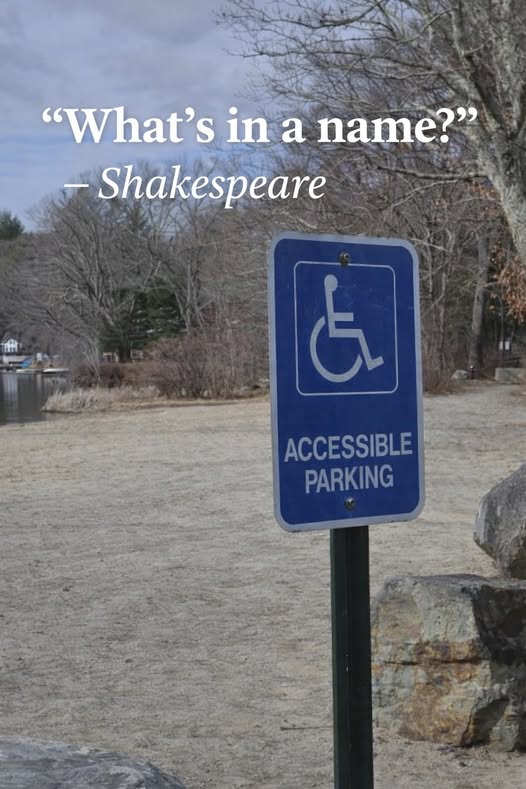
“What’s in a name?” – William Shakespeare, Romeo and Juliet, Act 2, Scene 2
After my last post, which ended up getting over 13,000 views, it was pretty clear this topic struck a chord. That tells me one thing. If I did not fully understand it, there is a good chance others did not either.
So I wanted to do a quick follow-up, especially after hearing a few different interpretations of the wording on the signs at Heart Pond.
A few years back, those parking signs were replaced when things were shifted around for the lifeguard areas. If you look now, you will see something you do not normally get to see. Two signs, side by side, with different wording. One says “HP,” and the other says “Accessible Parking.”
At first glance, that feels like it should mean something different. And based on some of the conversations, that is precisely how people are reading it.
So I did what I usually do. I took a second look.
What I found is that what you are seeing is really a timeline.
Years ago, most signs said “Handicapped Parking” or just “HP.” That was the standard language at the time. Then things shifted to “Reserved Parking” with the symbol, focusing more on the space than the person. Over time, as language evolved, that moved again to “Accessible Parking,” which is what you are seeing on newer signs today.
Even at the federal level, this change was made official fairly recently. The newest sign standards now use “Accessible Parking,” while older versions are still out there because signs are replaced over time, not all at once.
Massachusetts is right in the middle of that transition as well. Some of the laws still use older wording, while the signs being installed today use the newer language.
So what you are seeing at Heart Pond is something you do not usually notice. It is the evolution of the wording, side by side, in real time.
Different wording, same symbol, same rule.
If the sign has the wheelchair symbol, it is a reserved space. The wording underneath might change, but the meaning does not.
And honestly, this was a good reminder for me too. You hear something, you take it at face value, and then you go check. No harm in that, and you usually learn something along the way.
“I see it feelingly.”
— William Shakespeare, King Lear, Act 4, Scene 6
In plain terms, sometimes you just have to look twice to really understand what you are seeing.