There was a comment recently that the current garden at Sunny Meadow was “not truly accessible.” That made me stop and think a bit.
We have not seen full public plans yet for the new garden changes, so rather than speculate, I figured it was worth talking about what accessibility actually looks like in a real, working garden.
A couple of years ago, a new set of raised beds went in at the Senior Center. That project taught a lot about accessibility, sustainability, and how to build these things the right way from the ground up. Those beds are wood, designed mainly for standing use, but they already had accessible beds in place. What they did well was mix heights. They did not try to make every bed the same.
That is really the first key point.
If you are putting in 13 new beds, accessibility is not one size fits all. A good mix would look something like this:
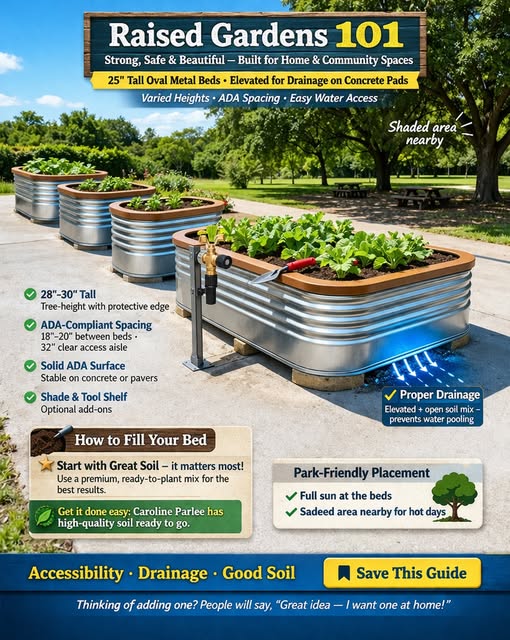
A couple at 28 to 30 inches for wheelchair use
A group around 24 inches for seated or reduced bending
Some lower beds are around 18 to 20 inches for traditional use
Not every bed needs to serve the same person, but the overall layout should serve the whole community.
The second issue is something people do not always think about with metal beds. Heat. Powder-coated steel is durable, but in the sun it will get hot. Not maybe, it will. So, you need a top edge. Something like a composite or wood cap so people can lean, rest tools, and not come into contact with hot metal. That is both comfort and safety.
Third is the surface around the beds. If we are going to call something accessible, it needs a solid, stable ADA surface. No cracks that catch wheels, no uneven transitions. You need to be able to move around the beds easily and safely.
Water access matters too. It needs to be easy to reach without dragging hoses across paths or creating trip hazards. I talked a few weeks ago about a simple “bolt-on” connection that can be added to almost any faucet. These are used on rail trails and in community gardens and are designed with accessibility in mind, including easier reach and control.
And then there is the part that no one sees but will matter the most a year from now. Drainage.
These beds are going on a concrete pad. If they sit flat, water has nowhere to go. It will sit, the soil stays wet, and that is when you get mold, smell, and poor growing conditions. The right way to do it is simple:
Raise the beds slightly off the concrete so water and air can move
Do not seal the bottom tight
Add a layer of stone inside the bed so water drains instead of pooling
If you get that part wrong, everything else looks good on day one but fails over time.
And one more piece that is just as important as anything above. Soil.
A raised garden is not a lawn. You cannot just dump dirt in and expect it to work.
For the raised gardens at the Senior Center, we went to Caroline Parlee’s farm and had a truckload of soil and loam mixed in the right proportions. It was done locally, by someone who understands the soil here, and it made all the difference.
A good working mix looks like:
About 40% compost
About 40% screened loam
About 20% material that helps drainage, like sand, pine bark fines, or perlite
That balance gives you:
Nutrients from the compost
Structure from the loam
Drainage so roots do not sit in water
If your soil is right, you do not need to keep adding fertilizer. The beds at the Senior Center produce a massive number of plants every year because the mix was done right from the start.
If your soil is wrong, you are fighting it every season.
When these new plots go in at Sunny Meadow, plenty of people are going to look at them and say, “That’s a great idea; I want one at home.” And you can absolutely do that. But behind how these look, there is real science and safety in how they are built.
So, if you are thinking about doing one, think about this, especially how you fill your bed. Most of all, get good soil. Caroline Parlee has that ready to go right here in town.
So, when we talk about “truly accessible,” it is more than just one bed at the right height. It is height, layout, surface, safety, water, drainage, and what you put in the bed to begin with.
Done right, this could be a great upgrade for the community.
And just to note, these 13 new plots are expected to go live in April at $10 a year, and they are looking for people to sign up.
Hopefully we see the full plans soon so everyone can understand how it all comes together.