
A Simple Idea for Making Outdoor Water Connections More Accessible
I was in the shop at Sunny Meadow recently and came across a box full of connectors and splitters used for water systems.
These are the fittings that are added to faucets every spring so multiple connections can be made, or so an open spigot is available for filling watering cans. This box of splitters and connectors is really there to make water access easier for gardeners.
But looking at them, I started thinking about something else. Does it actually help all gardeners and users?
Along with the garden plots, we also have water connections used for pollinator gardens, drinking water, and a wash station. The same connectors and splitters are often used on those connections as well.
That got me thinking.
When the community garden watering systems were designed years ago, accessibility was considered, but really only to the level required. Making it accessible meant making sure a couple of the spigots, maybe two or three at best, were reachable and usable. That met the requirement.
But standing there looking at that box of connectors, I started wondering if we could do better.
One thing I have learned over the years is that a simple outdoor faucet can actually be adapted in plenty of ways.
That sent me down a bit of a research path.
Many communities and rail trails have faced the same question. How do you make outdoor water connections easier for people to use? Most of the solutions installed in parks are commercial bottle-filling stations. They work well, but they are expensive and usually require electricity and permanent plumbing changes.
So I started looking for something simpler.
The idea was to find something that
• requires no electricity
• does not modify the existing faucet
• Can connect and disconnect easily
• Can be removed in winter for freeze protection
• stays very low cost
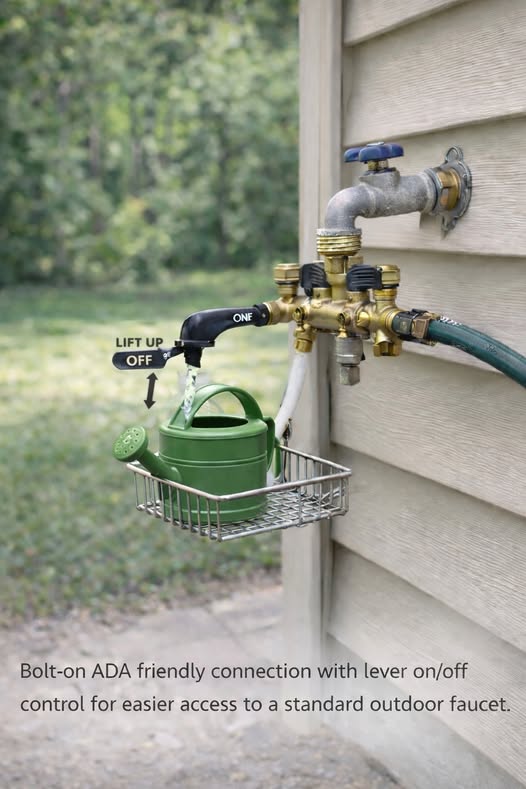
What I found were several bolt-on connectors like the one shown in the image.
They attach directly to a standard outdoor faucet and add a lever-operated outlet that is much easier to use. Instead of twisting a round knob, the lever simply pushes down for on and lifts for off.
A small support basket allows a bottle or container to sit while filling so the user does not need to hold it in place.
The nice part is that nothing about the original faucet needs to change. The attachment can be installed when needed and removed just as easily.
It would work on a community garden spigot, a park water connection, or any standard outdoor faucet that might be installed for future projects.
Sometimes the right way to approach a problem is not asking
“How do we make the connection accessible?”
But instead of asking
“How do we bring accessibility to the person who needs it?”
This design is a variation on solutions already used in a number of places. The parts are simple plumbing fittings, and the total cost of the attachment is only about $50 to $80, depending on the exact parts used. For something that can make a standard faucet much easier to use, that price seems like a huge return on investment.
I am not asking the town to use this or the gardeners to use this. The idea is simply that it could be a great addition to the box of connectors that already exists. Like any box of connectors, you look for the one that works best for the situation.
Why not add one of these so it is available if someone needs it?