The Sap is Running in Chelmsford
The maple season is now fully underway, and the new sugar bush at Sunny Meadow Farm is already showing what it can do.
With the new tapping method, we are seeing about 25 gallons of sap per day coming in from the Sunny Meadow trees. What makes this even more exciting is the higher sugar content in these trees. When you compare it to standard maple trees, the sap here really needs to be looked at almost like double the production.
And this is only the beginning.
Next year the plan is to tap around 200 trees, which could easily push production to 50 gallons of sap a day or more if the weather cooperates. If the season runs for several weeks, that is a tremendous amount of sap moving through the system.
And this is only one of the sugar bushes.
The traditional sugar bush in town is also producing heavily. That site uses two 125-gallon collection tanks, and they are typically emptied every single day during the run. When you step back and think about it, that is an enormous amount of sap moving through the system and eventually turning into syrup.
So how does all that sap become maple syrup?
Step 1 – Gathering the Sap
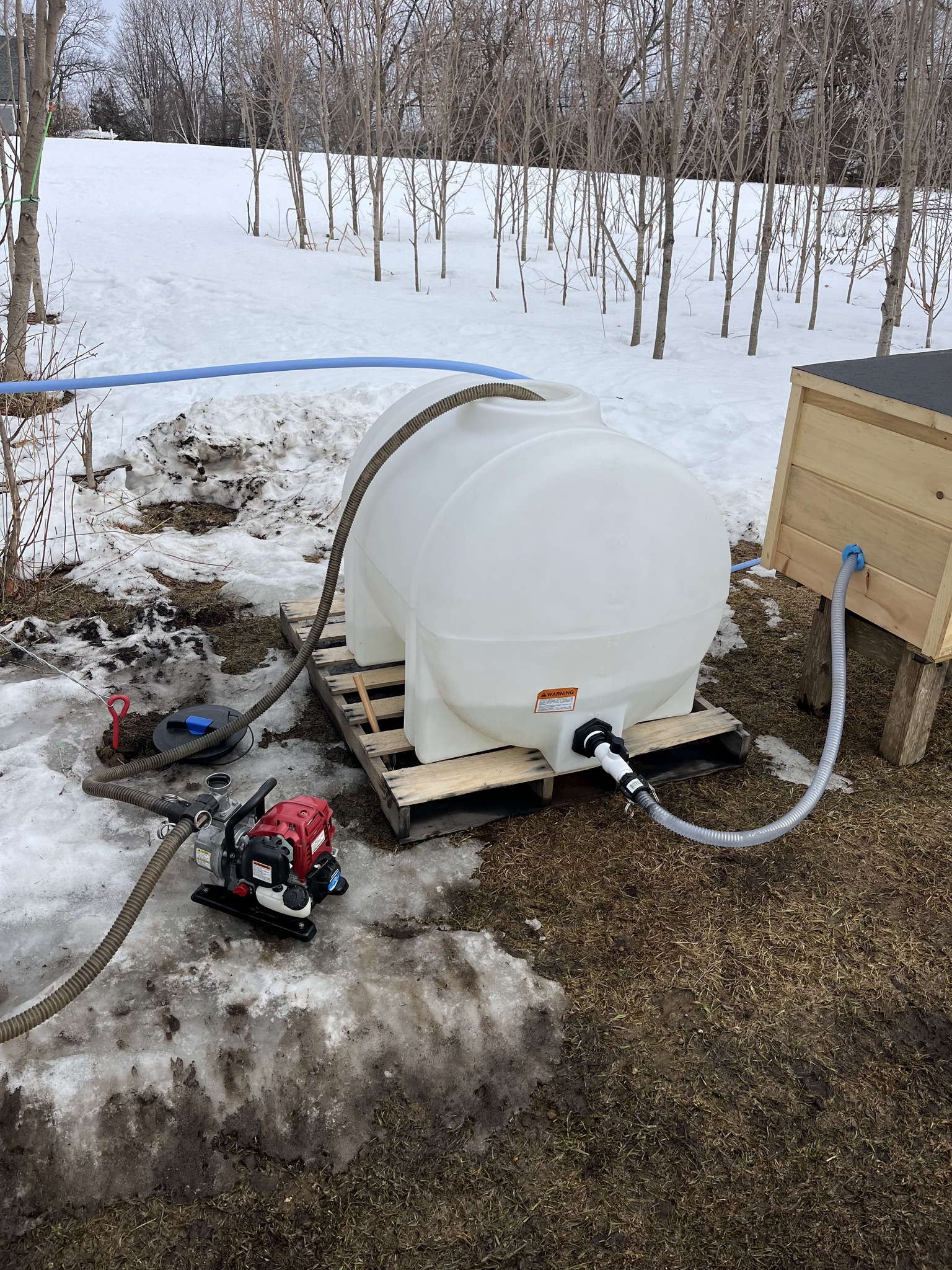
The first step is collecting the sap from the holding tanks in the woods. The sap is transferred into a transport tank mounted in the back of a truck.
That truck tank holds about 320 gallons, so if the trees are running hard, sometimes more than one trip is needed to move it all.
The sap from both sites is brought back to the sugar house for processing.
Step 2 – Reverse Osmosis
Once the sap arrives, it is transferred into a processing tank and then run through a reverse osmosis system.
This machine removes roughly 50 percent of the water from the sap before it ever reaches the boiler.
This is a huge step in modern maple production. The goal is simple. Remove as much water as possible before boiling so that less fuel is needed later.
Step 3 – Warming the Sap
After reverse osmosis, the concentrated sap moves into a tank at the sugar shack.
From there it is drawn into a sap warmer, which raises the temperature before it enters the boiler.
The key idea throughout the whole process is simple.
Remove water early and warm the sap so the boiler does less work later.
Step 4 – The Boiling Process
Now the real magic happens.
The warm sap enters the evaporator, which is essentially a long stainless boiling pan that works a bit like a maze. The sap slowly travels through different sections of the pan, boiling more and more as it moves forward.
As the water continues to evaporate, the sugar concentration rises.
The target temperature is about 219°F, which is roughly seven degrees above the boiling point of water and signals the sap has reached maple syrup density.
The evaporator pan is slightly tilted so the finished syrup collects at the far end.
Step 5 – The Bell Rings
When the syrup reaches that magic temperature, a valve automatically opens and the finished syrup flows into a stainless steel sealed bucket.
At that moment the person running the evaporator rings a bell.
It is a small moment, but it never gets old.
That bucket is moved aside to cool.
Step 6 – Finishing the Syrup
Even though it looks perfect at that moment, the syrup is not quite ready yet.
After a few days it is reheated, filtered to remove natural sugar sand, and then bottled.
Only then is it ready to sell.
Sugar Shack Fact #1
It usually takes about 40 gallons of maple sap to make just one gallon of syrup.
That is because most sap coming out of the tree is only about 2 percent sugar. The rest is water that has to be boiled away.
At Sunny Meadow the sap often has higher sugar content, which means it takes less sap to make a gallon of syrup. That saves time, fuel, and a lot of boiling.
Sugar Shack Fact #2
Pure maple syrup finishes at about 219°F, which is about seven degrees above the boiling point of water.
When the syrup reaches that temperature, the sugar concentration has reached the magic level of about 66 percent sugar. That is what gives maple syrup its thickness and keeps it from spoiling.
That moment when the syrup hits temperature and comes off the evaporator is one of the best parts of the whole process.
A Tradition Older Than the Town
Maple sugaring in New England goes back hundreds of years before Chelmsford was even founded in 1655.
Native Americans were the first to discover that maple sap could be boiled down into a sweet syrup and sugar. Early settlers in New England quickly adopted the practice because maple sugar became one of the few local sweeteners available before cane sugar was widely imported.
By the 1700s and early 1800s, many New England farms had a small sugar bush, a stand of maple trees tapped each spring to make syrup or maple sugar for the family.
The process was much harder back then. Sap was gathered by hand in wooden buckets and boiled for hours over open fires in iron kettles. A good run meant long days feeding the fire and hauling sap through the woods.
Today the technology has changed with tubing systems, reverse osmosis machines, and modern evaporators. But the basics are still the same.
A maple tree wakes up in late winter.
The sap begins to move.
And people gather it to turn it into something sweet.
That is why it is pretty special to realize that right here in Chelmsford we are still carrying on a tradition that farmers and families in New England have been doing for centuries.
The tools may be newer, but the moment when hot syrup first comes off the evaporator still feels the same.
The Taste of a New Season
The 2025 syrup season is almost completely sold out, which shows just how much people look forward to this every year.
The first batches of 2026 syrup should be ready in about a month.
But I will admit something.
I am not patient.
As soon as the syrup cools enough to be safe, I grab a little in a paper cup and take a taste. That hot, sweet, sticky syrup straight from the evaporator is something special.
And every time it happens, you know the same thing.
It will be another remarkable maple season here in Chelmsford.
Episode 4 Preview: The Sap Must Flow
With school and everything else going on this week, I will not be able to make it down to the sugar shack until Saturday.
When I do, I plan to film the next installment in the series.
Episode 4: The Sap Must Flow
Yes, a clear nod to Dune. I am a bit of a geek.
This episode will feature Jamie from Cooking Buckets Sugarhouse walking through the entire maple syrup process from start to finish. We will cover everything from the moment sap leaves the trees all the way to the final syrup coming off the evaporator.
The goal is to capture the whole operation in action and present it as a five-minute video for:
Episode 4 of Cooking Buckets: Making Syrup in Chelmsford, MA
You will get to see:
• Sap arriving at the sugar house
• The reverse osmosis system removing water
• The evaporator boiling the sap down
• The moment syrup hits the magic temperature
• And hopefully a fresh draw of syrup right off the pan
If all goes according to plan, and if I do not get distracted along the way, I will have the video online Saturday night.
For a few weeks each spring the woods wake up, the sap starts running, and the sugar shack fills with steam and the smell of maple.
It is one of those simple traditions that connects the land, the farmer, and the community.
And here in Chelmsford, when that first hot syrup comes off the evaporator, you realize something.
The sap is running, the season has begun, and for a little while the sweetest thing in town is being made right here.
And as the sugarmakers would say with a smile...
The Sap Must Flow.