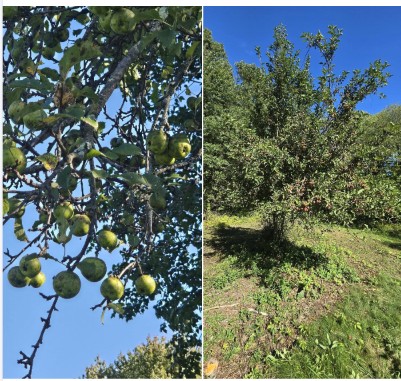
An apple tree on Chelmsford’s open space can tell us a story about the land, the people who worked it, and the wildlife still using it today.
Koulas Farm has two huge apple trees. At Red Wing Farm, an orchard was planted on the site of the original orchard. That orchard is now in trouble, and I think it deserves some attention.
With an initiative to remove nonnative trees from town land, these trees got me thinking. Before we start cutting, shouldn’t we consider the value they add? And shouldn’t exceptions be clearly written into any management plan?
Here in Massachusetts, our familiar apple trees are not native. Some are survivors from old orchards and farmyards. Others grew from seeds carried by wildlife or left behind by people. We would need more history to know the story of the two at Koulas, but they are part of the landscape we have now.
Being nonnative does not automatically make a tree invasive. That distinction matters when we make decisions about Chelmsford’s open space.
Apple trees feed wildlife. Deer, foxes, rabbits, wild turkeys, cedar waxwings, and other birds use the fruit or other parts of the tree. An apple with spots may never win a ribbon at the fair, but appearance alone does not erase its edible value.
Before the apples come the blossoms. Those spring flowers provide pollen and nectar for native bees, including bumblebees, mining bees, and native mason bees, as well as honeybees. The bloom does not last all season, but it contributes to the food supply.
That is a lot going on around an old apple tree.
These trees also connect us to Chelmsford’s farming history. Our open spaces include land that people planted, tended, harvested, and depended on. At Red Wing, planting an orchard where the original one stood carried that history forward. Seeing it in trouble makes me want to understand what is happening and what it would take to help.
I support controlling invasive plants and encouraging habitat. I also think good land management needs room for judgment. A completely inflexible plan can remove the advantages right along with the disadvantages.
Any plan should clearly allow us to consider an established tree’s wildlife value, historical connection, condition, and effect on the surrounding habitat. Those exceptions should be part of the plan from the beginning so the people doing the work have clear guidance.
There will be individual trees that need to come down for safety or a specific habitat reason. But “not native” alone is a poor reason to remove an established apple tree.
I hope we keep all our apple and fruit trees wherever we reasonably can. They provide food for animals, a connection to Chelmsford’s past, and occasionally a quick snack for a steward working on a summer day.
That seems like a pretty good return from a tree.