I was working in the warehouse this morning, listening to NPR as I love to do while I work, when a story came on called “Is homegrown food safer?” It made me think about a conversation I had at Sunny Meadow Farm about five years ago, and a concern that has stayed with me ever since.
Here is the story, with about three and a half minutes of audio and the full transcript:
https://www.wvxu.org/2026-09-21/is-homegrown-food-safer
Back then, I was working with an organic farmer who told me he needed to grow somewhere else. When I asked why, he explained that he grew greens and would not use surface water to irrigate them. The irrigation pond is fed by groundwater and runoff, with animals living in and around it and birds using it. His concern was what that water might carry onto the food he was growing. Honestly, I thought he was a little crazy until I started looking into it myself.
In the NPR story, Michigan State University agricultural food safety expert Phil Tocco says, “Some backyard gardeners don’t understand the risks, the fecal risks.” That brought me right back to what the farmer at Sunny Meadow had been trying to explain. Tocco also describes the concern with using potentially contaminated rain-barrel water on something someone will soon eat, saying, “it’s like bacterial soup.” A rain barrel and an irrigation pond are different sources, but his concern about what irrigation water can carry onto food was familiar.
I asked other farmers and learned some interesting things. Most of the farmers I spoke with who drew from surface water told me they used filters, and some used old pool filters because they were inexpensive and could work with the pressure from an existing pump. I even went out and got one, but I could not get the okay to install it on the gas-powered system at the time. A filter alone would not establish that the water was safe, but I wanted us to take a closer look at what we were pumping onto the gardens.
Now we have a new pump, but as I understand it, there is still no filter, and raw pond water is pumped to the community gardens and other greenhouses. From my conversations at the time, I learned that Farmer Chey used town water for his greens and Busa had a deep well. Those conversations made me pay more attention to where irrigation water comes from and how it is used, especially on lettuce and other greens we eat raw.
At the community gardens, the black water lines run above ground. On a hot day, the water comes out hot for a short time before cooling down, and I have always wondered about the condition of that water sitting in those lines. The temperature alone does not tell us whether it is contaminated, but it certainly makes me wonder what testing would show.
That concern was part of the thinking behind an Eagle Scout project to build a produce wash station right beside the gardens, using town water. COSS covers the water cost because we felt that having a place to wash produce, with free access to town water, would help. The NPR story ends with Consumer Reports food safety expert James Rogers recommending that people wash produce with water regardless of where it was grown. Washing is a useful step, although it cannot guarantee that contaminated produce becomes safe. The wash station roof needs repair, and we are going to take care of that, but if gardeners are not using the station, I have to ask why we are paying for the water. We put it there to be used.
The NPR story also elaborates on manure as fertilizer, which is another practice I have concerns about when the manure is raw and has not been properly treated or composted. There is a difference between raw manure and properly finished compost, and what we put into the soil deserves attention along with what we spray onto the plants.
I have always worried that one day the conditions might be just right for the water quality to cause a problem. I cannot tell you the pond water is contaminated without testing, but I also do not think we should assume it is fine. As summers get hotter and water levels drop, I wonder how the quality will change and whether we will pay attention before there is an issue.
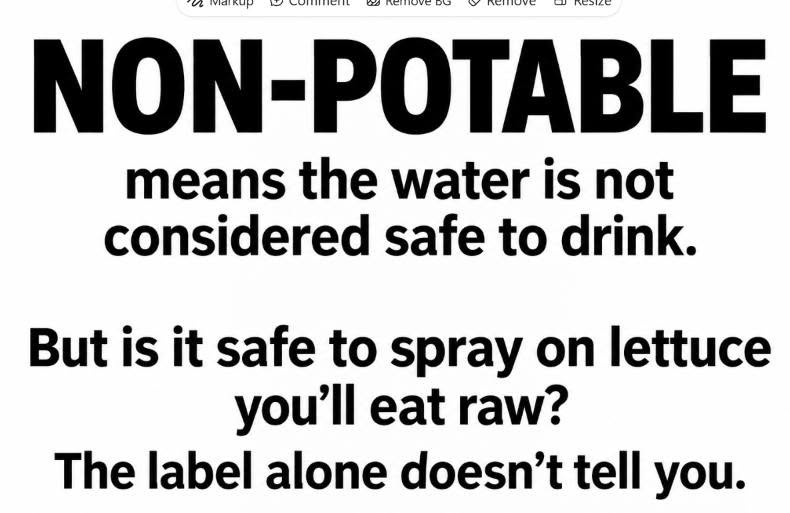
Speaking with that organic farmer all those years ago made me think, and this morning’s NPR story brought it all back. From where I stand, the same questions are still there. Give the story a listen and see what you think. Just because water comes out of a tap does not make it drinking water, especially when that tap is connected to a pond. If we would not drink it, I think it is fair to ask what we know about it before spraying it onto lettuce we plan to eat raw.