
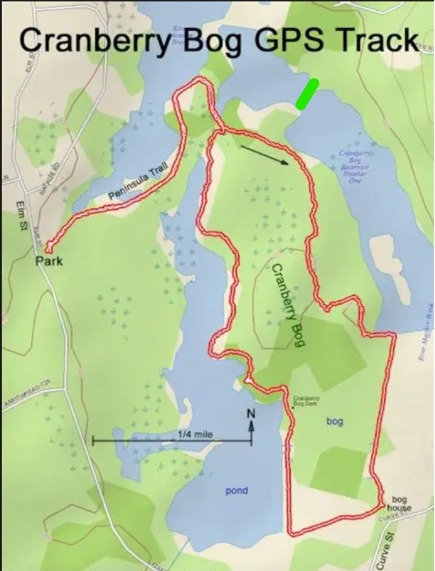
I spent some time digging into the Chelmsford side of the cranberry bog dam, and like plenty of things in town, once you start pulling on the thread, the story gets a lot bigger than what you see from the trail.
Most people walk out there and see a pond and a path.
What is really out there is a managed water system that has been worked on, funded, repaired, and adjusted for well over a hundred years.
Let me start with what we actually know from Chelmsford records.
Back in FY07, after a failure in 2006, Chelmsford put real money into this. Town Meeting approved about $60,000 through CPA funding to rebuild the dam that forms the Chelmsford portion of the cranberry bog. That was not maintenance. That was a rebuild after a collapse. That tells you right away this structure matters.
Then fast forward to more recent work.
At the Spring 2020 Town Meeting, there was another article tied directly to the cranberry bog dam off Elm Street. This time the funding was about $25,000, and the purpose was different. The Finance Committee minutes make it clear that a conservation review found the dam had been diminished by tree and brush overgrowth. The money was to bring in a contractor to clear that growth and stabilize the structure.
So right there you have two clear data points.
Around $60,000 in the early 2000s for a rebuild after failure.
Around $25,000 in 2020 for targeted maintenance and stabilization.
This is not a one-time project. It is something that has needed attention over time.
Now here is where it gets interesting and where most people do not realize what they are actually looking at.
There is not just one dam.
One of the things very few people know is that there is a large beaver dam upstream, and it plays a major role in keeping the Chelmsford side water levels high. Before water ever reaches the town’s dam, it has already been held back and spread out. That beaver dam is actively shaping the upper part of the system.
Then there is the trail.
If you walk it and really pay attention, the trail itself is not just a path. It is a connected string of small dams and berms left over from the old cranberry operations. Those structures still function today. They help form and hold one side of the pond on the Chelmsford side. You are literally walking along part of the water control system.
And then there is the dam everyone is talking about, the one that went through Town Meeting.
That structure is regulated. It has to be maintained. It has been inspected, repaired, and funded through public votes. Furthermore, it is part of the town’s responsibility.
But it is only one piece.
When you step back, what you really have is a layered system:
A rebuilt town dam was funded in FY07 after a failure.
Follow-up maintenance was funded in 2020 to keep it functional.
A series of smaller historic berms and control points along the trail.
An active beaver dam upstream is holding and spreading water naturally.
All of these are working together whether we planned it that way or not.
This is also not isolated to Chelmsford.
There has been a joint Chelmsford and Carlisle group that has met over the years, typically once or twice a year before COVID, to discuss the cranberry bog, water levels, and dam-related issues. That alone tells you this is a shared system. What happens on one side effects the other.
So, when you hear discussions about dams, water levels, or changes in the bog, it is never just about one structure. It is about how all of these pieces interact.
What looks like a quiet pond is really the result of:
A dam that failed and was rebuilt.
Ongoing town meeting funding decisions.
Historic agricultural infrastructure is still shaping the land.
Active wildlife engineering by beavers.
And coordination between two towns trying to manage a shared resource.
If you are walking that trail, you are not just walking next to water.
You are walking through a system that has been built, rebuilt, and adjusted and now continues to evolve in real time.
And honestly, the more I dig into it, the more questions it raises.