Yesterday’s Volunteer Day was actually more than just a volunteer day. It was a window into where we are in Chelmsford as a community.
Over 35 groups attended. But the real story is not just who came. It is who was missing, the mix of groups, and what they were saying to each other.
If you step back, you can break the groups into a few categories.
First are the traditional organizations with fixed locations. The Historical Society, Garrison House, and The Wish Project. These are rooted, physical places in town and part of our shared history.
Then you have the groups that meet regularly. Lions, Chelmsford Women of Today, and the garden clubs. We actually have a number of garden clubs, enough that they form their own strong category.
There are also service organizations supporting elders and homebound residents. State and regional groups like the National Park Service and libraries. Political groups. And open space groups like COSS and Friends of Koulas.
And then there are the connectors. The people and groups that cross between categories and help tie everything together.
What you really see is a web. Some parts are strong. Some parts are thinner. But it is still a web, and it still holds.
Across almost all of them, there is one common theme. They need volunteers. Now more than ever.
Looking across the room, you could also see something else. Not a hard gap, but missing generations. Most volunteers are 50-plus, and many are 60-plus. That middle layer that used to naturally feed into these groups is not as present as it once was.
When I was growing up, community events were how people met, talked, and had fun. That has shifted. A lot of that connection has moved online. Younger generations are finding community in different ways, often from home. Meetings, coordination, and even events are trending more virtual.
COVID accelerated that shift. Fifteen or twenty years ago we had more in-person events. COVID disrupted that rhythm, and even as things reopened, habits had changed. People found what was easier, and some of that has stayed.
Companies changed as well. Community outreach used to be something they naturally did. COVID slowed that down, and many shifted their focus or moved those efforts online.
And the workforce shifted. That group that often fueled community involvement found themselves focused more on work and stability.
Government is also under pressure. Costs are up, expectations are high, and the gap between what people want and what can be delivered is real.
That is the reality.
But that is not the whole story.
In the middle of all of this, you have these volunteer groups. We’re still showing up. We’re still believing in what community means in the real world.
And that is what stood out most to me.
The passion.
These are not people just going through the motions. They care. When they talk, it is from the heart. You can see it. They believe they can improve things.
And that matters.
In the first hour, before the public comes in, you see something special. Groups talking to each other. Sharing ideas. Comparing notes. Asking how we bring younger families back into the real-world community.
There was a clear theme.
Not big events. Smaller ones.
Music with under 50 people
Classes and lectures
Walks
Playdates
Community cleanups
Things that are simple, real, and easy to connect with.
I was there wearing plenty of hats, like many of us do. COSS, pollinator gardens, peony gardens, scouting, and ADA advocacy. That is pretty typical. Most of us involved in this space are connected to more than one thing.
And that early part of the day is really a forum. The value of that is difficult to measure.
We had long conversations. Idea exchanges. Offers of support. Shared goals.
The Conservation Commission spent close to an hour speaking with us about upcoming changes. They asked how both COSS and Friends of Koulas see the current state of open space and how we improve transparency between government and community groups so we are not working at cross purposes.
It was also a chance to reconnect with people you just do not see enough. Life gets busy. But those connections are still there.
Garden clubs, Wish Project, Chelmsford Women of Today, Historical Society, Garrison House, and many others. Friendships get refreshed. Respect is reinforced. Communication picks back up. And with that comes energy.
There were also some groups I was surprised not to see, and it is worth noting because they are an important part of the bigger picture. Scouts, who really represent youth volunteerism in action. Chelmsford Land Conservation Trust. The Conservation Commission volunteer group. Some of the high school clubs that could help bridge that missing generation. And possibly even a broader connection of church-based volunteer groups.
Their absence was not a negative. It was more a reminder. The full volunteer community in Chelmsford is even bigger than what we saw in the room, and there is an opportunity to bring more of that together.
Then the public starts coming in.
You see a few different types of visitors.
Some come to check in with groups they are already part of. Asking how they can do more.
Some come with questions. Real conversations about how things are, how they could be, and how we get there.
We had a lot of discussion about how COSS has been communicating lately. Longer narrative posts, more transparency, more information, and real-world options. People notice that. They appreciate having somewhere to go where things are explained clearly.
We also heard the same questions again and again.
How do I find events
What needs fixing
How can I help
What new ideas are out there
And then there are the people ready to step in and volunteer.
But again, the ratio is telling. Roughly five to one, older or retiring volunteers compared to younger ones.
That is just where we are right now.
But that does not mean we cannot shift it.
Over the next few days, I will share some of the ideas that came out of this.
Restarting New Friends of Roberts Field
Reforming the Friends of Roberts Field advisory board and expanding it to include other parks
New flower gardens
More small, community-based events
Approachable things. Things that meet people where they are today.
So was Volunteer Day a success for recruiting new volunteers
It was ok.
Nevertheless, was it critical as a forum to strengthen the volunteer community?
Absolutely critical!
It reconnected people. It built energy. Furthermore, it reminded us where we came from.
And maybe more importantly, it gave a clearer picture of where we are now.
And from that, you can start to see where we can go.
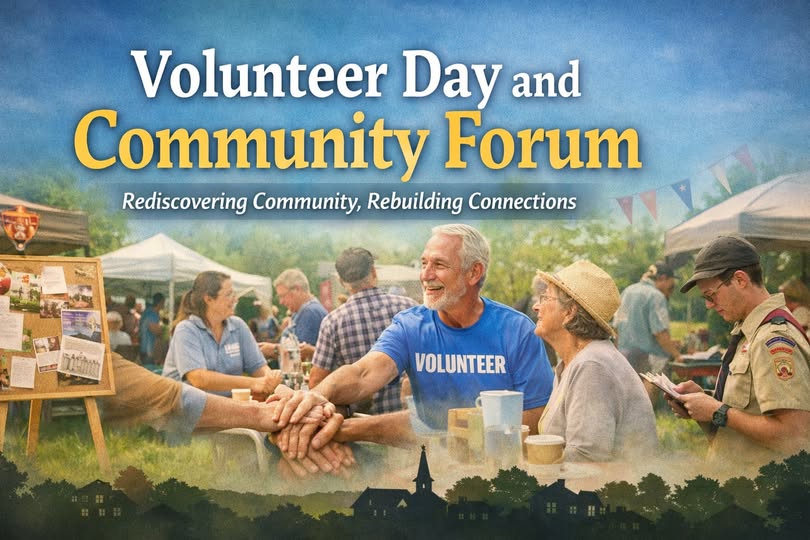
Perhaps next year we call it what it really is.
Volunteer Day and Community Forum.
Because that is what it felt like.
The world has changed. There is no question about that. Some of that change is here to stay.
But there is still a strong group of people who want to keep real-world community alive.
Not instead of the online world, but alongside it.
A place where people meet, talk, exchange ideas, and laugh together.
That is community.
And yesterday showed that not only is it still here, but it is ready to grow again.
These are my personal views – Phil Stanway