Sometimes a simple question can open the door to a much bigger story.
Someone recently suggested that, as the trees grow, perhaps branches from them could someday be used to graft new trees. Those new trees could be planted at conservation sites, parks like Roberts Field, or even near gathering places around town. The idea of having beautiful shade trees in public spaces is appealing on its own. But the idea that those trees could trace their lineage back to a historic tree from the Chelmsford Common makes it even more special. It could even become part of a fun “nature hunt” or local history story.
What many people may not realize is that this idea was part of the thinking from the very beginning.
This story actually goes back to the historic purple beech tree that once stood on the Chelmsford Common. For generations it was one of the most recognizable trees in town and became something of a symbol for Chelmsford.
Years ago the tree began to look like it might be in trouble. My gut told me that if something happened to it, that piece of living history could disappear overnight. So quietly, and outside the normal town structure, I worked with Weston Nurseries to see if we could take cuttings and attempt grafts.
At the time, when I mentioned that the effort was underway, I received a fairly sharp email saying the tree was fine and that suggesting it needed saving was premature.
That conversation happened in February.
By the Fourth of July that same year, the Purple Beech on the Common was gone.
Thankfully, the cuttings had already been taken.
Weston Nurseries did the incredibly delicate work of grafting the new trees. Their professional time and expertise on this project were well north of $10,000. It was a tremendous gift to the residents of Chelmsford, and they are really the heroes of the story.
Two of those grafts were successful, and today both trees are thriving here in Chelmsford.
Their locations were chosen intentionally. One of the lessons learned is that projects like this can become complicated when placed fully inside municipal systems. Chelmsford is essentially a $140+ million municipal operation, and sometimes the paperwork and regulations involved in something like this can outweigh the benefits.
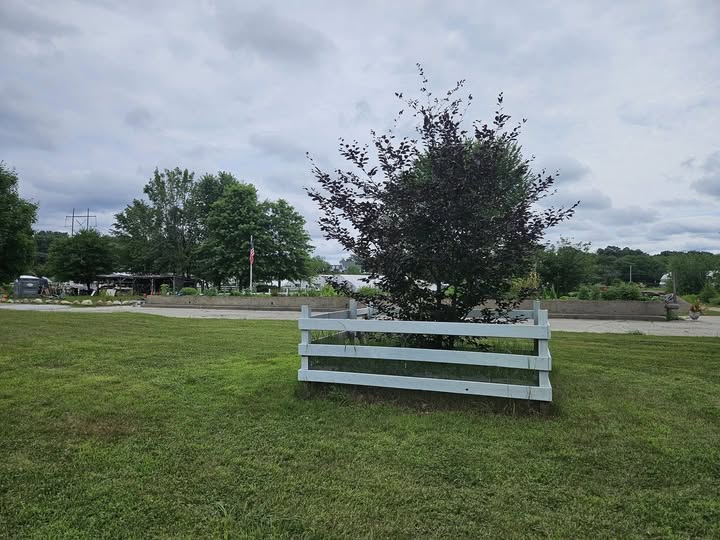
So one of the trees was intentionally placed on private land owned by a nonprofit organization, where it is cared for by residents who value the history and the community connection. That was always the “plan B” for protecting the legacy of the original tree.
Now, years later, the idea that these two trees could someday produce new grafts of their own is a wonderful thought. Imagine future purple beeches planted at parks, conservation lands, or gathering spaces around town, each carrying a living connection back to the tree that once stood on the Common.
Sometimes trusting your instincts, even when others are skeptical, can preserve something important.
In this case, a small act of planning helped ensure that a piece of Chelmsford’s living history did not disappear forever.
The photo is of the Purple Beech at Sunny Meadow; its twin is located at Garrison House.