Crooked Spring—A Walk Through Time, Water, and Change
Today I had a little spare time, so I went down to take a look at the dam and the lower part of Crooked Spring.
That pond, the dam, and the area below it have a long history, along with a few challenges that have been managed over the years. Conservation handles the site directly, so I will stick to sharing what I have learned over time and what I saw today.
Knowing a site deeply is important if you want to take care of it.
From what I have been told by a few of the “old-timers,” this pond started out as a fishing pond. It was built and stocked for years. The upper part of the pond had sandy areas that were ideal for fish to spawn in.
In the winter, it doubled as a skating spot. I have even heard stories that, occasionally, people would park a car out on the ice. Different times.
The pond itself was much deeper back then. On the right side of the dam, there was a control pipe system. Boards could be removed to drain the pond so it could be mucked out and maintained. I remember those boards. Some would be taken out for the winter and put back in during the spring, very similar to how Heart Pond used to be handled.
Everything worked well for a long time.
Then one day I pulled in to check on things, and something felt off. It took a second to realize what it was.
The pond was gone.
The control pipe had failed, and as designed, it drained the pond. Just not at a time anyone expected.
There was an effort to fix it. The proper fix required building a cofferdam, but the cost was just too high. So instead, about twenty of us showed up, filled sandbags, and built a cofferdam by hand around the broken pipe. DPW came in, replaced the pipe, and everything was back to normal.
For a while.
Then a second section of the pipe failed, and the pond drained again. At that point, no one could find the original plans, and rebuilding the system just was not realistic.
There was talk about removing the dam entirely. The state would have covered that part, but the town would have been responsible for restoring the wetlands. If I recall correctly, that was in the range of a million dollars. That made the decision pretty easy.
The solution was to pump cement into the pipe and seal it.
That stopped the leaking, but it also meant the pond could no longer be drained and mucked out. Over time, especially after a big storm and what may have been a beaver dam failure upstream, a large amount of debris, weeds, and soil washed into the pond.
Today it is only a few feet deep in many places, and it does not support fish the way it once did.
What Is Happening at the Dam
The dam itself has slowly changed over the years.
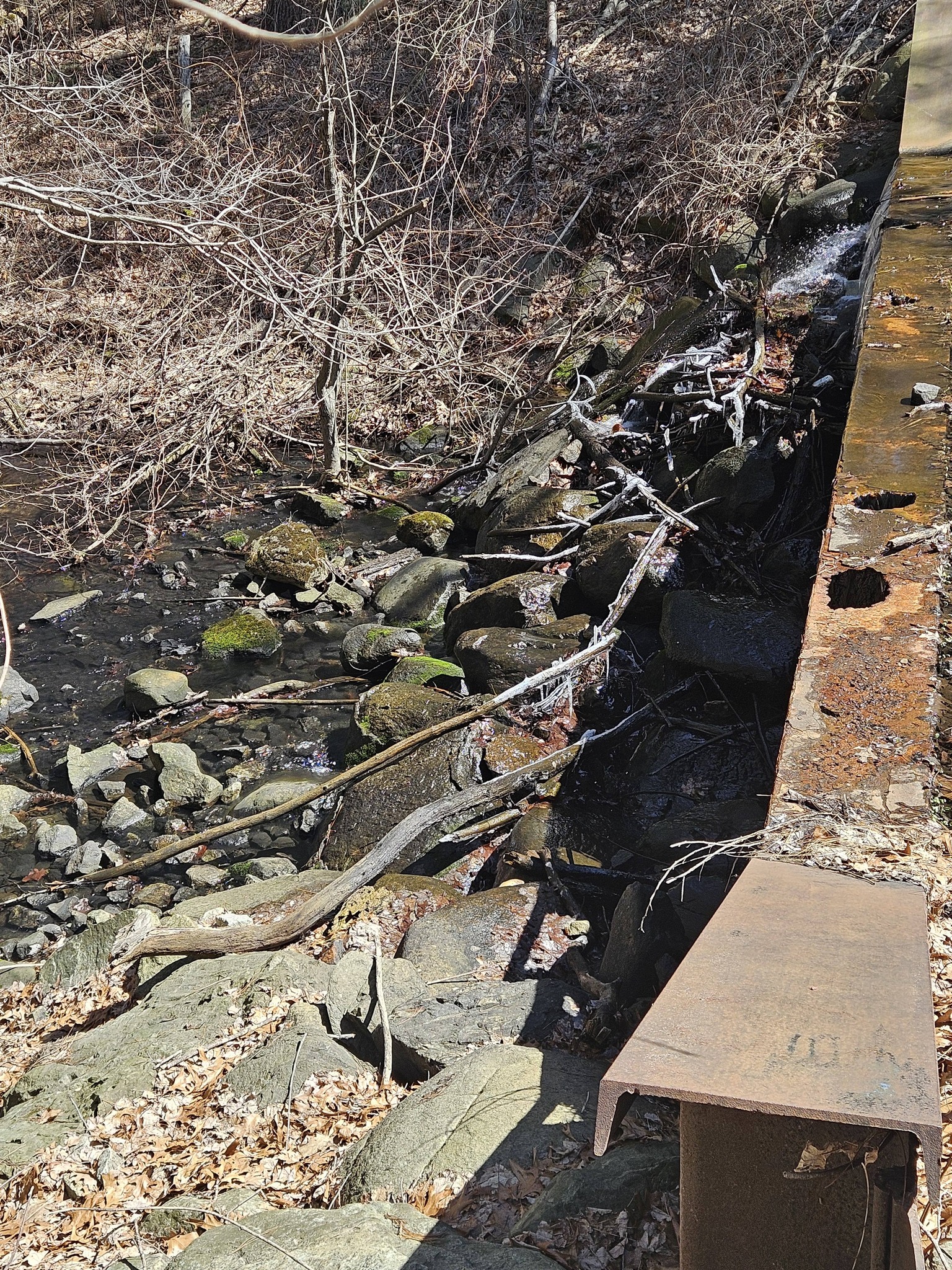
On the upper ledge, especially on the left side, there has been a small hole forming. Each year it has gotten a little bigger. Today it is to the point where most of the water is pushing through those holes instead of flowing cleanly over the dam.
There are two concerns with that.
The first is safety. People still walk across that metal edge to cross, even though they are not supposed to. There is a decent drop on the other side, and plenty of large rocks waiting if you slip. Not a great combination.
The second is what happens downstream.
Wood and debris build up at the dam from trees dying and falling on site. During heavy storms, all of that gets pushed downstream toward the culvert. That culvert is older and undersized by today’s standards. When it blocks, the water backs up and can get close to overtopping the road. I have seen that happen more than once.
For years, one of the simplest ways we managed that risk was with a spring cleanup. Boots on, walk below the dam, and pull out as much loose wood as we can and move it above the high water line.
Nothing complicated, just steady work that made a real difference.
That is still something that helps.
The crossing issue is also why the bridge near the culvert was built as an Eagle Scout project. It gives people a safer way across, even if not everyone uses it.
The condition of that upper lip on the dam is something I will flag to the town. That is not a volunteer fix. That needs someone with the right expertise to take a look.
What’s That Green Stuff in the Water?
One thing that really stood out to me today was the amount of green material in the water. At first glance it looks like some kind of plant, but my best guess is that it’s filamentous algae. It grows in long, hair-like strands along the bottom, and then, when conditions are right, it lifts and forms those floating mats you see drifting around.
It’s easy to look at that and think something is wrong.
But the more I thought about it, the more it made sense for this site.
This pond is not what it used to be. It is shallower, it holds more organic material, and it no longer gets drained and cleaned out like it did years ago. Add in sunlight and slower-moving water, and this is precisely the kind of environment where algae will show up.
So the real question is not “Why is it there?” but “Does it need to be managed?”
Presently, I would say no. Not in any aggressive way.
Some algae is normal. It is part of the system. What we are seeing looks more like a natural response to how the pond has changed over time, not a sudden problem that needs fixing.
That said, it is something to keep an eye on.
If it ever starts covering the entire surface, or if we start seeing signs that fish and other life are struggling, then that is a different conversation. But what I saw today was more patchy, and honestly, pretty typical for a shallow pond like this.
Now here is the important part.
With town wells downstream, this is not a place where we experiment or try quick fixes. No chemicals, no treatments, no shortcuts. Anything that goes into that water has somewhere to go, and that matters.
So if there is any “management” to be done, it is the simple kind.
Pulling loose floating mats near the edges. Clearing out dead wood below the dam so it does not build up and block flow. The same kind of boots-on-the-ground work that has helped this site for years.
Nothing fancy. Just paying attention.
At the end of the day, what we are really seeing is a pond that is slowly evolving. Less of a managed fishing pond and more of a natural wetland system.
And that is not necessarily a bad thing.
It just means we need to understand it, respect it, and take care of it the right way.