
Tucked back in the woods along the old alignment of Misty Meadow Road is a small piece of Chelmsford history that almost no one ever sees. The road itself was moved long ago, and the entire original route was decommissioned. Today only the name remains, and the road itself now only exists on historic maps along with many other long-gone farm roads that once crossed Chelmsford.
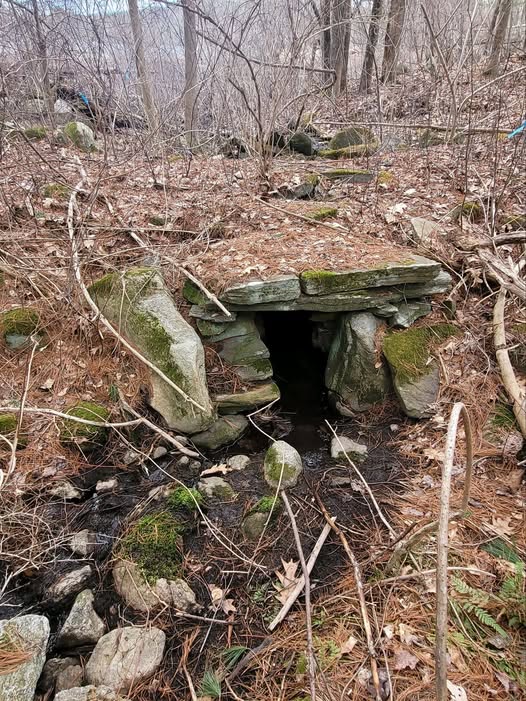
This small stacked stone bridge still marks where the old farm road once crossed this drainage.
This bridge sits off the trail and was part of the original farm road that once ran through this section of the property. Decades ago the road was relocated, and today the surrounding land is private property, but this little bridge was simply left behind. Over time leaves, soil, and brush slowly buried it and it disappeared into the woods.
As we keep working on the Koulas site we keep finding links to our past, and this is no different.
This spring we plan to clean up the area and expose the entire bridge along with a short section of the original roadbed so people can see what early farm infrastructure actually looked like.
What makes it interesting is how it was built.
There are no nails, no metal, no concrete, and no machinery involved. This is what is known as a dry laid stone culvert. Farmers dug a small channel for the water, placed large foundation stones on each side, and then carefully stacked flat stones across the top to form the roof. The weight of the stones and careful placement keeps everything locked together. Dirt was then packed over the top to create the road surface for wagons and livestock.
If you look closely you can see how the builders selected flat stones for the cap and larger fieldstones for the sides. The water passes through the stone tunnel underneath while the road once ran across the top.
This type of construction was common all over New England in the 1700s and 1800s. Farmers clearing their fields were constantly pulling stones out of the soil. Instead of hauling them away, the stones became building material for just about everything. Stone walls, foundations, culverts, bridges, and even small dams.
And in Chelmsford we certainly had no shortage of stone.
These structures were built by hand, one rock at a time, usually by the same farmers who were working the surrounding fields. Many of them have lasted well over a hundred years because gravity and careful stone placement is surprisingly durable engineering.
Once the brush is cleared people will be able to step over and take a closer look at the craftsmanship. The road itself cannot be walked because it now crosses private land, but this little bridge remains as a reminder of the early farm roads that once connected fields and farms across the landscape.
This is not the only item on our list. We recently learned there may also be a rock in the front meadow where the daughters of the farmer would sit and do their homework while waiting for time to bring in the cows for the night. We are not sure exactly which rock it was, so if anyone knows we would love to identify it. It would be a wonderful addition to the farming history of the site if kids today could sit there and imagine the field filled with dairy cows just as the Koulas daughters did all those years ago.