Most people do not know how maple syrup is actually made. They see a bottle on a shelf. Maybe a bucket hanging on a tree in an old photo. That is about it.
Here is what is really happening.
In late winter, when nights drop below freezing and days warm above freezing, maple trees build internal pressure. That pressure moves sap through the tree. We drill a small hole, insert a tap, collect the sap, and then boil it down. It takes about 40 gallons of sap to make one gallon of syrup.
That basic process has not changed in centuries.
What has changed is how we tap and collect that sap.
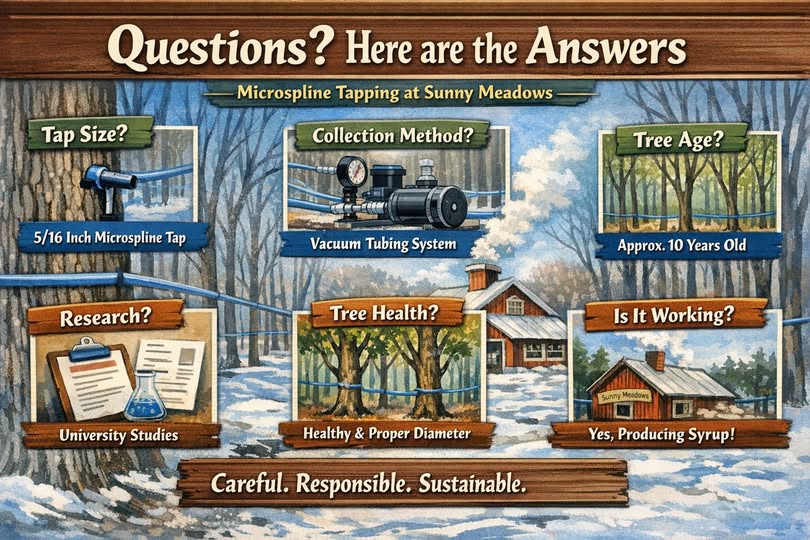
For decades the standard tap size was 7/16 of an inch. Then research at the University of Vermont Proctor Maple Research Center showed that smaller taps produced similar yields while creating less internal damage inside the tree. The industry shifted to 5/16-inch taps as a new standard.
Sunny Meadow is going even smaller.
The system being used is 3/16-inch taps and tubing with vacuum assist.
That means the hole drilled into the tree is smaller than the modern 5/16 standard. A smaller hole means less internal wood impact and faster healing when done properly.
Now let’s discuss the vacuum part, because that word makes people nervous.
Vacuum in maple production is not suctioning the tree dry. It is not pulling sap out of a tree that is not ready. It simply improves the natural flow of sap that is already moving during freeze-thaw cycles. Think of it as helping the sap travel through the tubing efficiently once it leaves the tree.
Vacuum systems have been used in New England maple production for decades. They are mainstream. Combined with small-diameter taps, they increase efficiency while staying within accepted tapping guidelines when properly managed.
Now here is the bigger question people are asking.
Is it viable long term?
Yes, when managed properly.
This is leased town farmland being managed for maple production. The sugar bush was intentionally planted years ago for that purpose. These are not random, unmanaged forest trees. They were grown with maple production in mind.
Using 3/16 taps with vacuum is not magic. It is not some experimental shortcut. It is simply modern maple technique. Smaller tap size. Efficient collection. Research-driven practice.
What makes something viable is not the tool. It is how the tool is used.
Healthy trees
Proper diameter before tapping
Limited taps per tree
Rotating tap holes year to year
Responsible vacuum levels
Good sanitation
Those are what determine long-term sustainability.
Across New England, many producers now use small-diameter taps and vacuum systems as their standard approach. These practices are supported by university maple research programs and standard industry practice.
On leased farmland like this, we are always looking at new products and new techniques. Small leased plots allow small-town farmers to try methods that may not happen on massive commercial acreage. That experimentation can lead to better practices and new ideas.
Chelmsford is a right-to-farm community, and that principle supports farmers who use responsible, research-backed practices.
Cooking Buckets Sugarhouse is using practices that align with accepted New England maple standards on cultivated agricultural land. The approach is careful, responsible, and grounded in research.
This is not about bending nature.
It is about working with it using updated tools and better understanding.
That is not magic.
That is agriculture evolving the way it always has.
Next onsite tour: Sat 28th at 9am
Shared as educational information. I am not speaking on behalf of the Town, COSS, or any board.