
Long before the town of Chelmsford existed on a map, the forests, wetlands, and river corridors of this area were home to Native peoples whose lives followed the seasons with great care and attention. Among them were the Pennacook and the Nipmuc, whose homelands included much of what is now central and northeastern Massachusetts. For these communities, maple sugaring was not a novelty or a hobby. It was a deeply rooted seasonal practice tied to survival, culture, and renewal.
As winter began to loosen its grip and daytime temperatures rose above freezing while nights still fell cold, sugar maples signaled that change was coming. Native families knew this moment well. In late winter, groups moved from winter shelters toward known maple groves, often returning to the same stands of trees year after year. The landscape around today’s Chelmsford, with its hardwood forests, wetlands, and nearby rivers, was ideally suited to this seasonal rhythm.
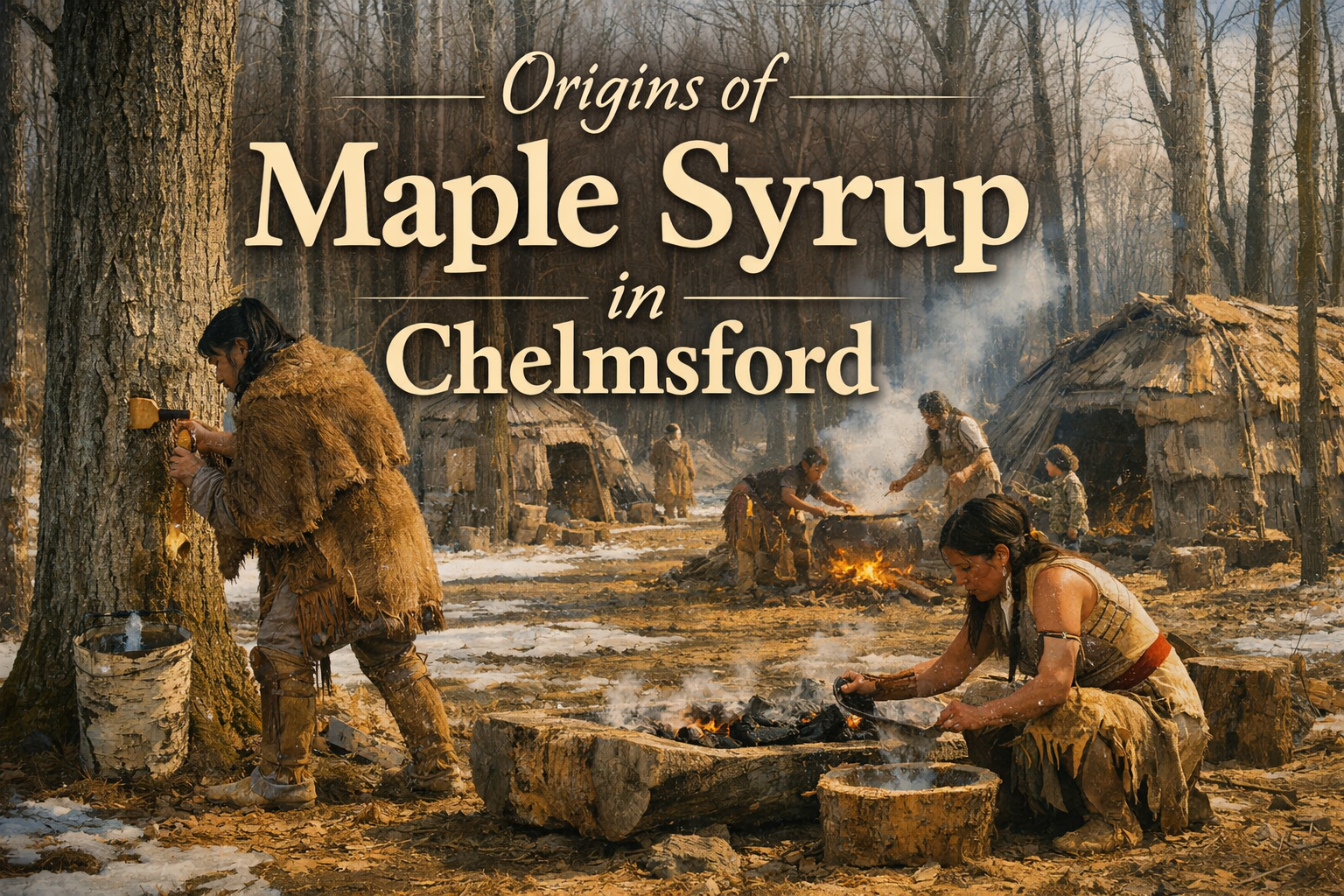
Pennacook and Nipmuc people harvested sap by making careful cuts in maple trees and guiding the sap into containers made from birch bark or hollowed wood. Without metal pots, they heated sap by dropping hot stones into the vessels, slowly evaporating water until it thickened or crystallized into maple sugar. Sugar, rather than syrup, was the preferred form. It stored well, traveled easily, and provided a reliable source of energy after a long winter when food was scarce.
The sugaring season was about far more than food. It was a time of gathering, shared labor, teaching, and storytelling. Elders passed down knowledge, families worked together, and thanks were given for the trees and the returning warmth. For many Native communities, maple sugar marked the first sweetness of the year, a sign that winter was ending and balance was being restored. The maple tree was not just a resource. It was part of a relationship built on respect, observation, and restraint.
When English settlers arrived in the 1600s and towns like Chelmsford began to take shape, they learned maple sugaring directly from Native people. Early colonial records make clear that the knowledge of when to tap, which trees to choose, and how to process sap came from Indigenous teachers. Metal kettles, spiles, and later sugar houses changed the tools, but not the timing or the fundamental understanding of the process. What eventually became known as a New England tradition was built on Native knowledge.
That legacy has not disappeared. In Chelmsford today, maple sugaring still happens each late winter, often quietly and without much fanfare. Taps go into trees when conditions are just right, sap runs for only a short window, and people gather to boil, watch, learn, and share stories. While modern tubing and evaporators may replace birch bark containers and hot stones, the rhythm of the season remains the same as it was centuries ago.
Places like Sunny Meadow Farm and other wooded conservation lands continue this cycle. Families, volunteers, and school groups experience firsthand what Native people understood long ago. The forest gives generously, but only if you pay attention, respect the season, and work with what nature provides.
Every gallon of maple syrup made from Chelmsford trees connects us to this place in a very real way, not just to today’s town, but to the people who understood these woods long before Chelmsford existed. It is a continuation of a tradition that began with Native peoples who paid close attention to the land, the seasons, and the trees and learned how to live with them rather than over them. That history deserves to be acknowledged every time sap starts to run.
What makes this even more meaningful is that the tradition is still growing. New trees are getting ready to be tapped this season thanks to Town Meeting and Chelmsford residents approving an extended 10-year lease for Cooking Buckets Sugar House at Sunny Meadow Farm. Some might say ten years is a long time to wait for a return on investment. I say, with a smile, Ten years? That is just a drop in the bucket compared to the centuries of maple sugaring that came before us here.