
Heart Pond is a well-loved but complicated site, and with ADA upgrades finally moving forward, it is important to understand the full context of the property, its history, and the real constraints that exist there.
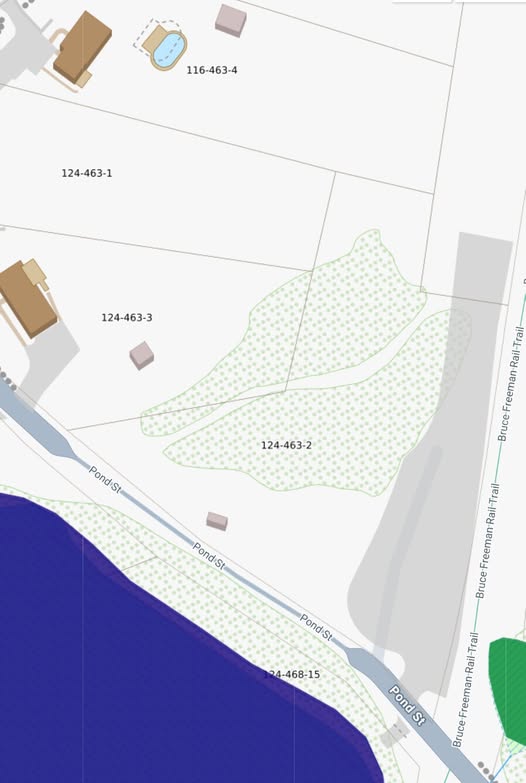
The town GIS map helps explain why this location is challenging. The park floods frequently, and a major reason is that Pond Street acts like a berm. There is no effective drainage from the park side of the road. There is a pipe that runs under the parking lot carrying a small stream from the far side of the Bruce Freeman Rail Trail into the pond, with the outlet located near the dock area. However, there is no connection between that pipe system and the park itself, so water backs up during storms.
Last fall the town ran a robot down that pipe. At the time it was suggested that a blockage may have been found and possibly removed. The current condition of the pipe still needs to be confirmed, and that is relevant for any future work at the site because drainage is one of the core problems at Heart Pond.
The dock is another unresolved issue. The dock that had been in place is currently over at DPW, and there has been no clear word yet on repairs or when or if it will return to the pond.
The parking lot presents several problems. It is surfaced with ground road paving’s, which tend to overheat and fuse in the summer. Over time, chunks break loose, creating potholes and loose debris. From both a safety and accessibility standpoint, it is not an ideal surface.
According to the town GIS, part of the existing parking lot extends into wetlands. That condition was grandfathered. Under today’s wetland setback requirements, a new parking lot or a substantially reworked one would likely require reconfiguration and a reduction in size. Some parking spaces are allocated to support the Bruce Freeman Rail Trail, and that number cannot be reduced, which further limits what can be changed.
The ownership history of the property matters as well. The land was originally owned by the town and later transferred to SCVA. After years of use, it was sold, and the private buyer wanted to build a house and close the road. That proposal sat in limbo for years. Eventually the property was sold back to the town. Town Meeting was presented with two options at that point. One was to use town funds, estimated at 225K. The other was to use CPC funds, which would require the site to be a public beach. Town Meeting chose the CPC option, which is why Heart Pond is now officially a public beach with public parking.
There has been infrastructure on the beach in the past. A small tool shed once existed but fell into disrepair. There was a plan to replace it through an Eagle Scout project, and that led to extensive discussion with CLCT about siting. The goal was to keep it out of the wetland buffer and to elevate it due to known flooding. The location where it ended up was effectively the only viable option. Placing it along the edge of the parking lot was considered but rejected due to the risk of damage during snow removal.
Several important site features were built through Scout projects. The bike rack was built by an Eagle Scout using cedar harvested from Wright Reservation. The kiosk currently on site is also an Eagle Scout project, as was the previous kiosk. When the playground was expanded, the old kiosk had to be removed. Because it was fixed in place, it broke during removal. That experience directly informed the design of the current kiosk. The new kiosk is secured with four bolts that allow it to be removed and relocated if needed. That change was added to the Eagle plan while it was being built and should allow the kiosk to remain functional for another 20 years.
The playground itself is intentionally small. It contains only two pieces of equipment. At one point there was discussion about adding more, but the required mulch safety zone would have removed a significant amount of green space. Once again, the guiding principle became that kids can play on grass, and the expansion was not pursued.
The site has always had four picnic tables, historically all built by Scouts, likely Troop 75. None of those tables are ADA accessible. The town later added two metal picnic tables, but neither of those is ADA accessible either. At this time there is not a single ADA compliant picnic table at Heart Pond.
Each side of the beach also has a small grass sitting area. The left side has three stacked stone benches, some of which came from Red Wing, along with one professionally installed bench. For many years there was also a fifth bench, a wooden bench near the dock that was maintained by Troop 75. That bench was retired after I was told a second professional bench would be installed. That was two or possibly three years ago. Whether that additional bench is included in the current ADA plans remains to be seen.
The boat ramp has its own history. When the town reacquired the property, the ramp was closed for safety reasons. Today it is only used by the Fire Department and by the Heart Pond Association in emergencies when there is no other option. The ramp was inadequate for CFD use and was extended a few feet. That extension required wetland mitigation, which was implemented behind the benches to restore an equivalent amount of wetland area. With wetlands so tight at Heart Pond, any work at this site requires careful review and mitigation planning.
Safety and supervision are also part of the site’s history. Many people do not know that a child drowned at this beach years ago. There is a rock at the bottom of the pond that bears his name. When the Town purchased the property, the family asked that lifeguards be present, and for many years lifeguards were on site. Eventually, due to conditions at the pond, the decision was made that lifeguards would not return. After that, the Town tried a monitoring program, but it only operated for a few months before it was also discontinued.
Today the beach has no lifeguards and no monitors. It does have working cameras and regular police patrols.
COSS is on-site during the week assisting with basic stewardship, including grass cutting, and helping support the facilities cleanup crew. Facilities increase staffing during the summer and do an excellent job maintaining the site. The beach is raked a few times each year, and goose poop patrol is ongoing.
Portable toilets are provided on-site from spring through fall and are generally well maintained. The maintenance company does not service units on weekends or holidays, so if something unusual occurs, such as a unit being tipped over, there can be a short delay before cleanup. The units are checked regularly, and any issues are called in and addressed.
There are clear use restrictions. Cooking, drinking, and smoking are not allowed per Board of Health regulations. The site currently has two handicap parking spaces.
Fishing rules sometimes cause confusion. Fishing is not allowed from the beach or from the dock when it is in place, and this rule appears to be largely self-policing. The best fishing access is from the boat ramp or from the two paths that come down from the Bruce Freeman Rail Trail.
Land ownership is important here. The area along the rail trail belongs to the town. Fishing to the right of the beach when looking out at the water, or crossing the small fence, places you on private land. The owner is protective of their property rights and that boundary needs to be respected. The land along the rail trail itself is a right of way for the trail. At one time there was a garden project along the rail trail, but that effort faded, and the area is now occupied by a simple bench.
There are known hazards on the site. Some areas have uneven surfaces, and there is a significant amount of poison ivy toward the back of the park. That area is within wetlands and cannot be sprayed. Instead, grass is cut extra low there to discourage the poison ivy from spreading into the main park.
The site also has features people really love. There is a mulberry tree that is a huge hit with wildlife and people alike. Three newer trees were planted to add shade and all appear to be thriving.
There are also numerous trash barrels on site. While it can seem excessive, they are necessary because some visitors still struggle to understand what they are used for.
Algae is another issue that affects Heart Pond, and it is not unique to this site. Algae is a growing problem on many local ponds. Heart Pond is surrounded by houses throughout its watershed. Runoff from lawns, driveways, and roofs flows toward the pond. Combined with hotter summers, increased population, and the shallow depth of the pond, conditions are ideal for algae growth.
What used to be a short algae event can now last weeks, and in some cases has extended as long as seven weeks. There is no easy fix. Summers are only getting hotter, and treatment options are limited. Education is a big part of the solution. That bright-green lawn may look great, but fertilizer runoff can directly contribute to a green, closed pond.
Accessibility to the water itself has been discussed in the past. At one-point funds were raised for a beach access ramp to improve accessibility. Those funds were eventually returned by the town to the family who donated them.
Residents have weighed in on proposed changes before. A few years ago there was a proposal to install a large blue exercise structure at Heart Pond. The town even painted a large box on the ground to show its footprint. It would have removed most of the green space. Residents were very vocal in opposing it at this location, with the simple argument that it is ok for kids to play on grass. That feedback mattered, and the equipment was installed elsewhere.
All of this history matters when talking about upgrades at Heart Pond. The site is under a conservation restriction, tightly constrained by wetlands, subject to flooding, affected by water quality issues, and shaped by many past decisions and community input. Any new work requires careful planning and a clear understanding of these realities.
We do know that Town Meeting allocated 150K for ADA improvements and that there is now an additional 68K grant for materials. With real funding in place, it is time to see the plans. As soon as those plans are available, they will be shared so residents can review them and be prepared for public input. An informed resident is a better resident, and the goal is to provide accurate information as early as possible.
It’s a lot, but there is a lot to this site.
-Phil
This material was reviewed for compliance with 501(c)(3) educational and non-advocacy standards