
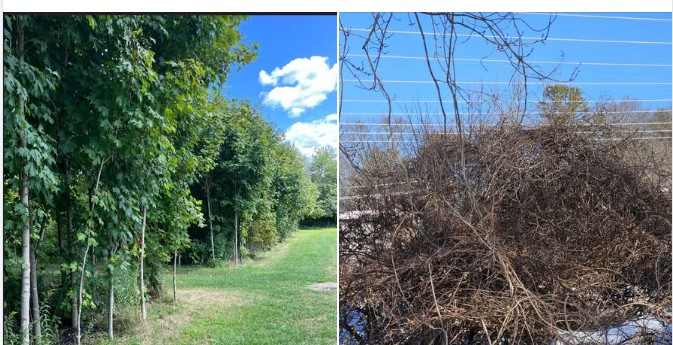
What a difference 100 feet makes.
Both of these photos were taken on the back hill at Sunny Meadow. They are separated by about 100 feet. The contrast is noticeable.
One photo shows the maintained sugar bush within the Cooking Buckets farm area. That stand of sugar maples has received consistent stewardship. Trees are pruned and observed over time. Invasive growth is periodically reduced. The forest floor has room to regenerate. The canopy appears balanced and stable. In summer it is full and green. In winter the branching structure of the maples stands out clearly. During tapping season, it also becomes a working example of small-scale New England agriculture.
The second photo is just beyond the stone wall from that area. It reflects woodland conditions where invasive species have become established over time. Bittersweet climbing into the canopy. Multiflora rose spreading through the understory. Vines competing with mature trees. Young native growth having difficulty gaining light and space.
When invasive pressure increases and is not periodically reduced, forest structure can gradually shift. Mature trees may experience additional stress. Openings in the canopy can allow more invasive growth to take hold. Over time, woodland composition can change in ways that reduce overall resilience.
Those who have worked on restoration projects at Koulas understand what long-term mitigation involves. It is steady, careful effort over years. Cutting vines before leaf-out. Prioritizing legacy trees. Reclaiming old roadbeds and stone walls. Encouraging native regeneration.
Out on that hill there is also an old road bordered by stone walls, similar to what we see at Koulas. It is a reminder that this land has been worked and cared for across generations. Maple production is one way that stewardship and agriculture can intersect in a woodland setting.
The maintained sugar bush demonstrates what intentional management can look like. It shows how agricultural use and conservation goals can coexist when guided by care and observation.
If a mitigation effort moves forward in this area, the focus would be straightforward. Protect mature trees. Reduce invasive competition. Support native regeneration.
Photos: Sunny Meadow Farm, summer 2025 and winter 2026
This is not about changing the character of the land. It is about supporting long-term forest health.
And sometimes, the difference becomes visible within just 100 feet.